
Marriage Supper of the Lamb
By Mike James
In Revelation 19:6-9 we read the following:
And I heard as it were the voice of a great multitude, and as the voice of many waters, and as the voice of mighty thunderings, saying, Alleluia: for the Lord God omnipotent reigneth. Let us be glad and rejoice, and give honour to him: for the marriage of the Lamb is come, and his wife hath made herself ready. And to her was granted that she should be arrayed in fine linen, clean and white: for the fine linen is the righteousness of saints. –
And he saith unto me, Write, Blessed are they which are called unto the marriage supper of the Lamb. And he saith unto me, These are the true sayings of God.
Some who believe this is a literal historic event claim we must go to heaven to experience this marriage supper of the lamb.
Is this “marriage of the Lamb” a literal event that will occur or is it symbolic of the new relationship between Jesus Christ and His people at the Second Coming? In other words, we will symbolically be married to Christ by the oneness of our relationship with Him at the Second Coming. The scriptures above in Revelation are the most explicit description of “the marriage supper of the Lamb.”
But we must acknowledge that the book of Revelation is a highly symbolic book that is not interpreted in the same way as most other books of the Bible.
For example, note in Revelation 1:1 the following: “The Revelation of Jesus Christ, which God gave unto him, to show unto his servants things which must shortly come to pass; and he sent and signified it by his angel unto his servant John” (KJV).
The Greek word for signified is semainein. It is rendered “made it known” in the New Revised Standard Version. The ancient Greeks used this same Greek word when they talked about what the Delphic oracles decreed by symbols. This same Greek word is also used in the Septuagint (Greek translation of the Old Testament) in Daniel 2:45 when it talks about the interpretation of a symbolic dream.
In using the word semainein, the original readers would’ve known John was going to define and convey truth through figurative or imaginative pictures rather than through plain language. Because God “signified” the message, the reader should expect God to communicate His message with symbolism. This symbolism was not meant to confuse; it was another mode to convey the message.
Some commentators go even further in terms of how to interpret Revelation. They say that seeing the word semainein, the original readers would have known to interpret Revelation figuratively until it’s obvious that they should do so literally.
Some connect the “sea of glass” in Revelation 4:6 and Revelation 15:2 with this “marriage supper of the Lamb” because the “sea of glass” relates to the purity and holiness of the Church, which is celebrated at the marriage supper. One problem with this theory is that the “sea of glass” is not mentioned in Revelation 19 where we read about the marriage supper. But when we look at the symbols that could be related to the “sea of glass” we find another issue.
First, note that the “sea of glass” is said to be before the throne of God in Revelation 4:6. In Revelation 15:2 we read that the righteous saints who gained victory over the Beast power are now standing on this “sea of glass.” If we keep in mind the idea of symbolic meaning in the book of Revelation, what could these symbols mean?
The answer might be found in 1 Kings 7:23-26 and 2 Chronicles 4:2–6. In 1 Kings 7:23-26 we read the following:
He made the Sea of cast metal, circular in shape, measuring ten cubits from rim to rim and five cubits high. It took a line of thirty cubits to measure around it. Below the rim, gourds encircled it—ten to a cubit. The gourds were cast in two rows in one piece with the Sea. The Sea stood on twelve bulls, three facing north, three facing west, three facing south, and three facing east. The Sea rested on top of them, and their hindquarters were toward the center. It was a handbreadth in thickness, and its rim was like the rim of a cup, like a lily blossom. It held two thousand baths. (NIV)
In Kings and Chronicles, we are reading about an item in Solomon’s temple called the “sea” which was a large bronze basin of water used for ceremonial cleansing before the priests could enter the temple. The “sea of glass” in Revelation could merely be a symbol of the fact the saved “kings and priests” of God (Revelation 5:10) have been cleansed and will be saved by God when Christ returns to resurrect them from the dead.
Standing on the sea could merely mean the cleansing nature of water impacting the saints. The water has made them clean and ready for the fuller relationship with Christ in the spirit realm. Also remember, water is a symbol throughout the Bible used to represent the Spirit of God. Note also that fire is mentioned as mingled with the sea of glass in Revelation 15:2. Fire is a symbol in Scripture of judgment and tribulation. The saints who overcome the beast will be tried and tested and go through a fire symbolically.
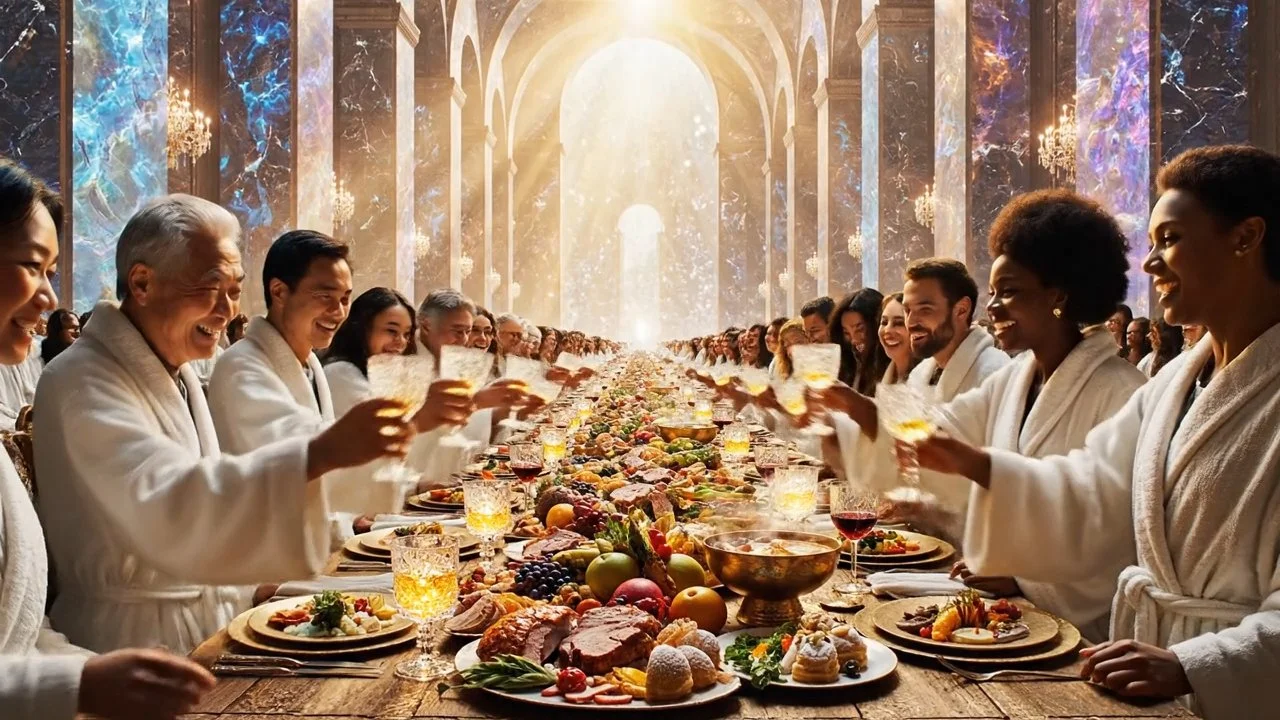
The marriage supper of the lamb does not need to happen in heaven. Note what the symbolic scriptures in Revelation might be referring to in Isaiah 25:6-9:
And in this mountain shall the Lord of hosts make unto all people a feast of fat things, a feast of wines on the lees, of fat things full of marrow, of wines on the lees well refined.
And he will destroy in this mountain the face of the covering cast over all people, and the vail that is spread over all nations.
He will swallow up death in victory; and the Lord God will wipe away tears from off all faces; and the rebuke of his people shall he take away from off all the earth: for the Lord hath spoken it.
And it shall be said in that day, Lo, this is our God; we have waited for him, and he will save us: this is the Lord; we have waited for him, we will be glad and rejoice in his salvation. (KJV)
This sounds a lot like a marriage supper to me, and it is taking place on earth in the context of Christ’s Second Coming (Revelation 19).
Sources:
The Book of Revelation for Dummies, by Larry R. Helyer and Richard Wagner, (Indianapolis: Wiley Publishing, Inc., 2008).
“White Paper: A Biblicist Defense of the Feast of Trumpets, the Sea of Glass, and the Wedding Supper of the Lamb,” by Nathan Bright, September 24, 2025, https://edgeinducedcohesion.blog/2025/09/24/white-paper-a-biblicist-defense-of-the-feast-of-trumpets-the-sea-of-glass-and-the-wedding-supper-of-the-lamb/
The Expositor’s Bible Commentary, Volume 4, (Grand Rapids: Zondervan Publishing House, 1988).