
Veneration or Idolatry?
by Mike James
To understand the difference between veneration and idolatry, we need to define our terms. According to the Merriam-Webster Dictionary, veneration is respect or awe inspired by the dignity, wisdom, dedication, or talent of a person. The same source defines idolatry as the worship of a physical object as a god or an immoderate attachment or devotion to something. So, there is a distinction between the two words, but when you have great awe or respect for someone or something, it could easily lead to idolatry.
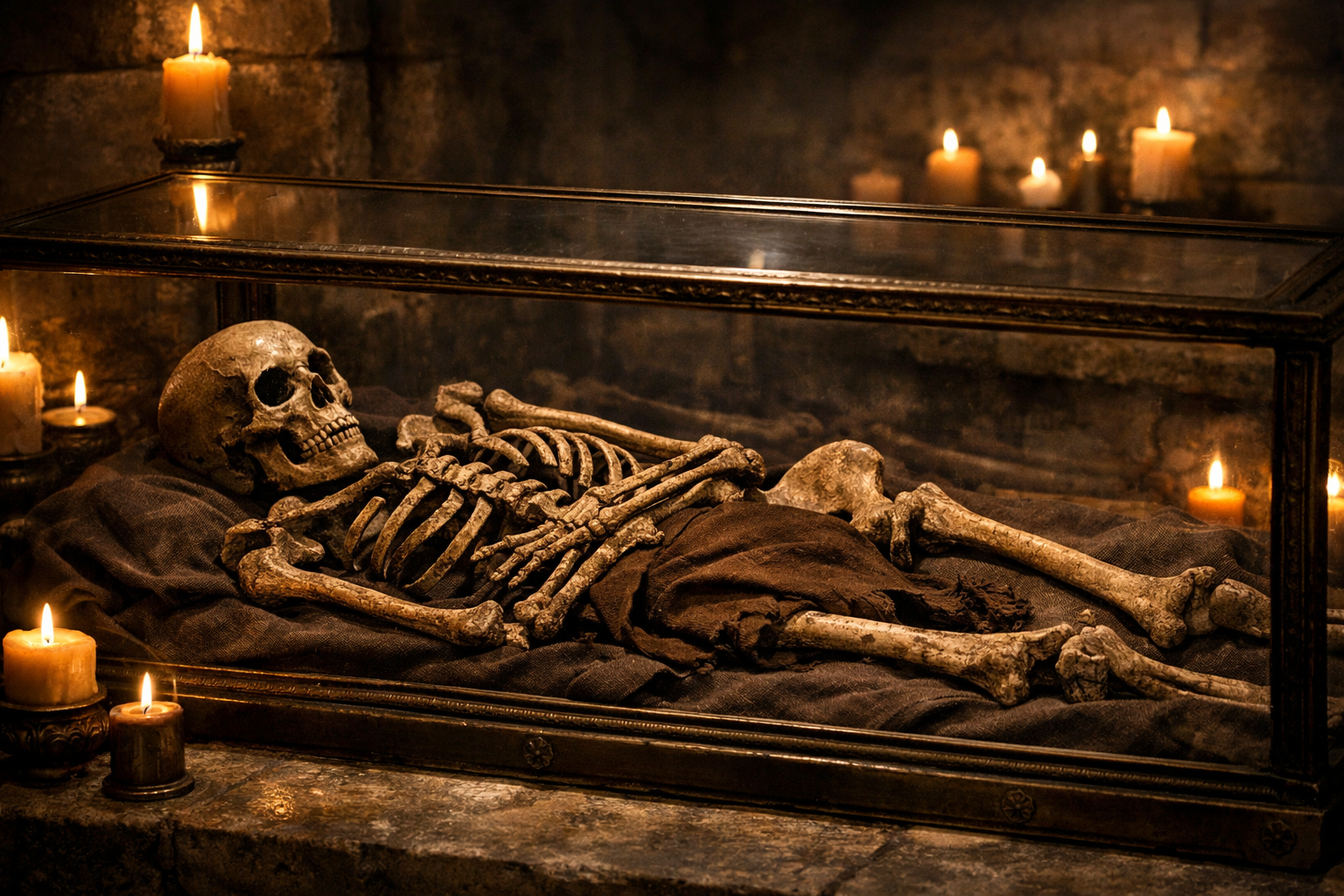
The bones of St. Francis of Assisi are presently on display in Assisi, Italy, until March 22. The display is commemorating the 800th anniversary of his death this year. Up to half a million people are expected to view the bones in a glass box in a church.
This is the first time the remains are going on public display in this manner. The decision to remove them from the crypt and display them for a month is a way to keep his message alive and give Christians a chance to pray before them, officials said.
But the month-long celebration will also be a boon to the shopkeepers of Assisi.
"Other people will see what we see every day," with Francis's spirit imbuing the town, said shopkeeper Arianna Catarinelli, who works in a souvenir shop in the main drag of town leading to the basilica. The shop includes Assisi-emblazoned sweatshirts, pens featuring another new saint named Carlo Acutis, St. Francis-themed coffee mugs, and neon rosaries.
"For residents, finding parking isn't easy. But for businesses, I think it's positive that there are so many people," she said.
There is no doubt that many of the pilgrims who visit relics and shrines promoted by the Roman Catholic Church and the Eastern Orthodox Church are sincere. But one negative aspect of relic, shrine, and saint veneration is how it can become idolatrous.
I grew up in the Greek Orthodox Church, and my grandfather emigrated to the United States from Greece. He related several stories to me that he had heard pertaining to the power of the saints and their relics.
In fact, one of his stories pertained to his journey to live in the United States. There was a church in Greece where believers could place a coin on an icon of Mary, the mother of Jesus. If the coin remained on the icon, it would mean your wish would be granted. My grandfather believed Mary answered his prayers in allowing him to safely move to the United States because the coin remained on the icon.
But where did this custom begin? Ancient pagans practiced similar things. Lucian (second century A.D. writer) mentions a statue of Pelichus, to whose thigh silver coins were placed with wax, because it was believed to have healing powers. This comes from Walter Hyde's book on Greek Religion and It's Survivals.
From an AI summary, I learned this: "Coins were often placed in graves as offerings to ensure safe passage to the afterlife. The practice was linked to the belief in Charon, the ferryman of the Underworld, who required payment for passage. Offerings were made at temples to seek favor or blessings from specific gods."
Charon is a figure from Greek mythology. It is highly likely that the practice my grandfather learned in his Greek church had survived in some form from ancient pagan practices. Obviously, my grandfather did not think of it that way, but we all know that Mary could not provide safe passage for my grandfather because she is dead and unconscious (Ecclesiastes 9:5, 10; Psalm 146:3-4; Psalm 115:17; Psalm 6:5).
The Bible also makes it clear we are to focus on Jesus Christ and the Father in our worship and veneration and nothing else (Exodus 20:3-4). There is only one mediator between God and man, and that is Jesus Christ (1 Timothy 2:5). Veneration of saints, their icons, relics, and shrines is moving away from worship in spirit and truth (John 4:23) because to believe that saints or Mary can respond is not truth; it is a lie.
Both the Catholic and Orthodox Churches teach that the saints and Mary can be prayed to for intercession on our behalf. The saints and Mary are dead and asleep in their graves, waiting for a future resurrection. Only God can hear and answer prayers.
To learn more about this subject, please go to LITERATURE on this website and read Why We Don't Pray to Mary and the Saints, 1 and 2.
Sources:
"The Bones of St. Francis are Going on Public Display, a Mixed Blessing for Assisi" by Nicole Winfield, AP News, February 21, 2026
Greek Religion And Its Survivals, by Walter Hyde