
Alleged Bible Discrepancies #8
by Mike James
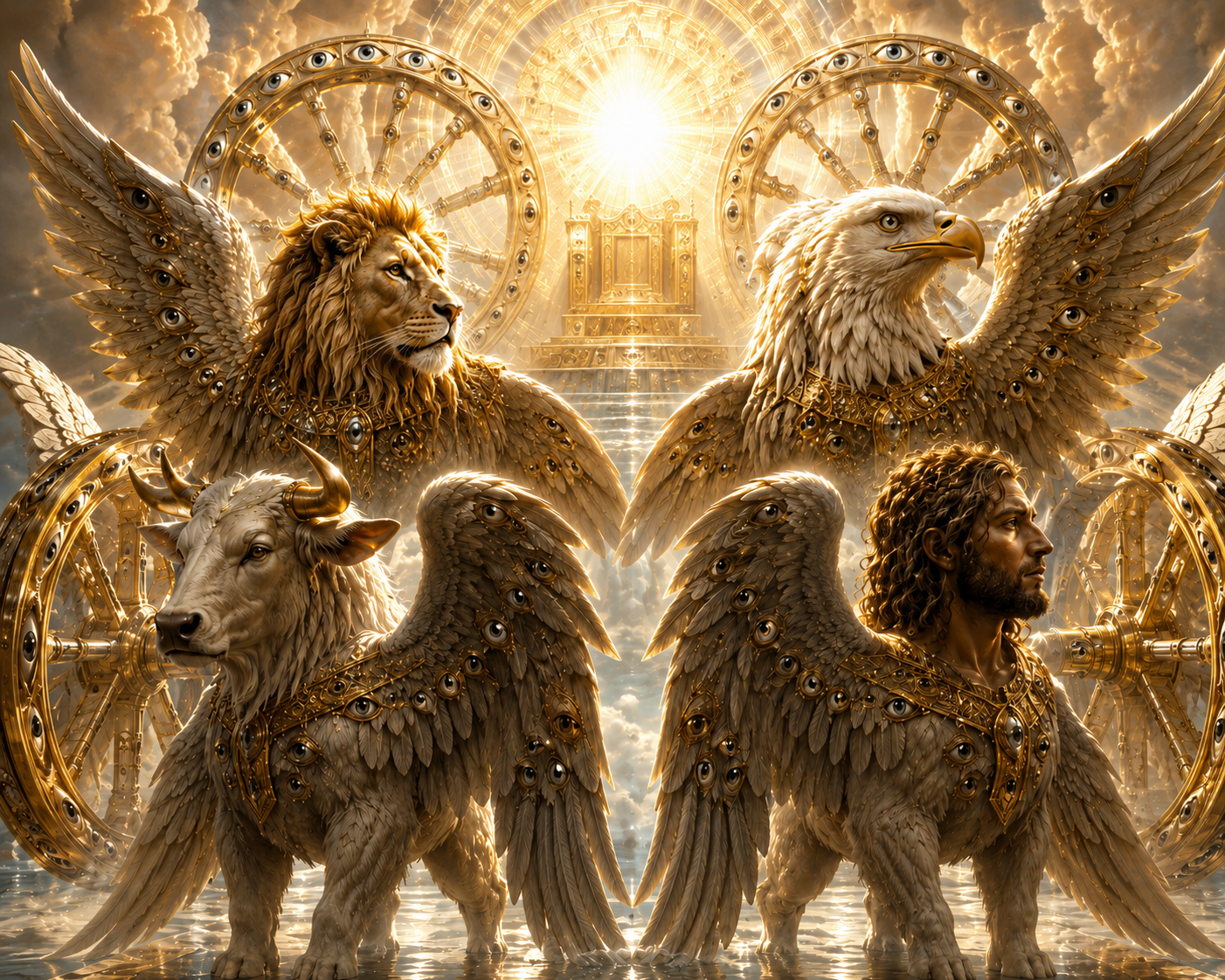
In the book of Ezekiel, chapters 1 and 10, there is a vision of God accompanied by wheels within wheels and cherubim. Here are the two similar descriptions with one slight difference.
Ezekiel 1:10: "As for the likeness of their faces, they four had the face of a man, and the face of a lion, on the right side: and they four had the face of an ox on the left side; they four also had the face of an eagle" (KJV).
Ezekiel 10:14: "And every one had four faces: the first face was the face of a cherub, and the second face was the face of a man, and the third the face of a lion, and the fourth the face of an eagle" (KJV).
Notice in the first verse one has the face of an ox, and in the second verse the face of a cherub. The other three faces are the same. Why this discrepancy?
There is one other scripture in the book of Revelation which addresses a similar scene to what we are reading above.
Revelation 4:6-8: "And before the throne there was a sea of glass like unto crystal: and in the midst of the throne, and round about the throne, were four beasts full of eyes before and behind. And the first beast was like a lion, and the second beast like a calf, and the third beast had a face as a man, and the fourth beast was like a flying eagle. And the four beasts had each of them six wings about him; and they were full of eyes within: and they rest not day and night, saying, Holy, holy, holy, Lord God Almighty, which was, and is, and is to come" (KJV).
Note that in this description, the four beasts are all the same except for the calf taking the place of the ox and cherub in Ezekiel 1 and 10. Now, a calf is similar to an ox; it could be considered a baby ox. The other similarities are that, in Revelation, the scene is God's throne room in heaven, and in Ezekiel's visions, the prophet is seeing God, who we believe exists in a throne room in heaven. The cherubim in Ezekiel 10 are full of eyes, as are the descriptions in Ezekiel 1 and Revelation 4. All three scriptures make note of the wings of these creatures too, so it is obvious that all three scriptures are talking about the same things.
Ezekiel provides more detailed information in the second vision when he tells us in Ezekiel 10:20 that he knew these figures were cherubim. He is not aware of that fact in Ezekiel 1, where he is seeing this sight for the first time. Or at least he does not tell us that in chapter 1. But he also confirms that these are the same four creatures in both chapters (Ezekiel 10:15, 20). He was at the Chebar River in chapter 1.
Another important point here is that in Ezekiel 1, God is coming onto the scene to commission Ezekiel, and in Ezekiel 10, He seems to be departing the scene. Each of these figures is a cherub as expressed in Ezekiel 10:14, and each has all four faces described here.
Was the writer merely changing the name cherub for ox because he knew the cherubs had four different faces? This face is the only one that is addressed with a different term in all three scriptures. According to one source, the winged bulls at the portals of Assyrian temples are called cherubs in Assyrian (Fried. Del. Paradies, p. 153, Lenormant, Les origines de l'histoire, p. 118), and they have the face of a man. Could the Assyrians have had corrupted knowledge about the angelic realm?
Is it possible that knowledge of angelic beings was known by other cultures besides Israel, due to the fact that legends could have grown up since the time of the Garden of Eden, where a cherubim guarded the entrance to the Garden of Eden so no one could enter it anymore (Genesis 3:24). Could this be why the ancient Egyptians had an ox god named Apis? This might be why the Israelites chose to worship a golden calf when Moses delayed coming down from the mountain.
We can't definitively determine why the writer chose different descriptive terms for one face of the four in the scriptures above. But far from being a discrepancy, there is logic in why one face is described differently in each of the relevant verses above. The writer knew that all four of the creatures were cherubs. And the face in question was of an ox or a younger ox.
Sources: Cambridge Bible for Schools and Colleges