
Historical Support for the New Testament
by Mike James
One of the reasons atheists and agnostics give for not believing in God is that they don't believe the Bible is true. I can't help these people develop faith and belief, but I can provide some historical information in this blog that could impact someone in giving the Bible a chance.
If someone does not want to be convinced by the Word of God, perhaps secular historians could provide a pathway for further investigation.
Tacitus was a first-century Roman historian who lived from about AD 56 to AD 120. His life coincided with the development of the Christian Church in the Roman world. In his book, Annals, written around AD 116, Tacitus mentions "Christus" (Jesus) and says that he was put to death under Pontius Pilate during the reign of Emperor Tiberius. This is a big deal because it corroborates the historical existence of Jesus outside of the New Testament. Tacitus also describes the persecution of Christians under Emperor Nero, which confirms persecution written about in the New Testament.
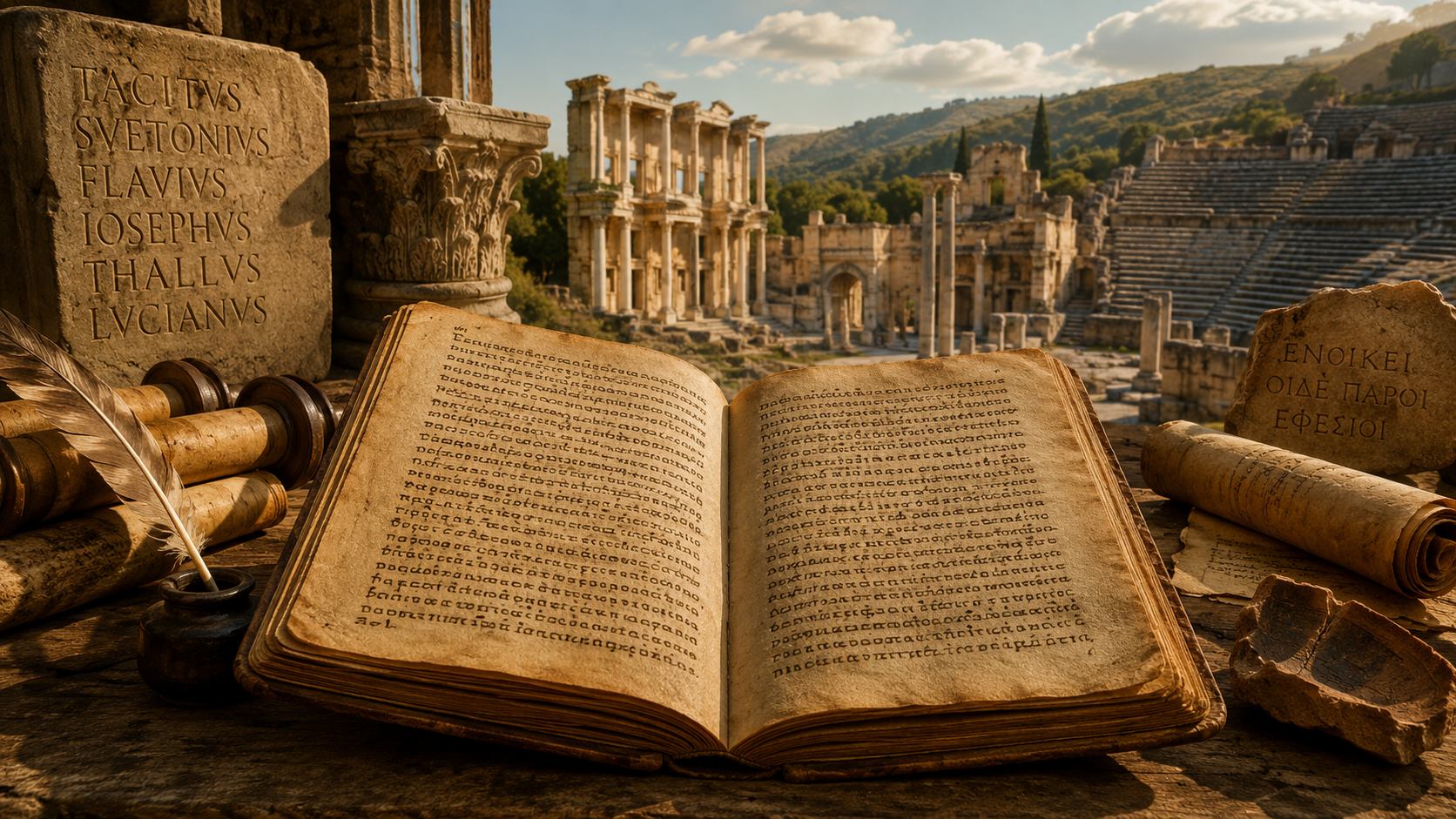
Ancient manuscripts, Roman historians, and archaeological discoveries all provide historical context that supports the New Testament record and invites a closer look at its claims.
Another Roman historian named Suetonius, who lived from about AD 69 to AD 122, was also a secretary for Emperor Hadrian. In his writings, he confirms what we read about in Acts 18:2: that Emperor Claudius commanded Jews to leave Rome in about AD 49.
Josephus, a Jewish historian, who was also a Pharisee, lived from about AD 37 to AD 100. He confirms the existence of Jesus in his writings and the fact that Jesus had a brother named James, who we believe wrote one of the New Testament books. Josephus also confirms the existence of John the Baptist as a historical figure outside of the New Testament record.
Thallus was probably a Samaritan, and he wrote around AD 50. Most of his writings are lost, but we do have some of his writings quoted by the Christian author Sextus Julius Africanus in his History of the World. Africanus lived from the late second century AD into the early third century AD. According to Africanus, Thallus, in the third book of his histories, refers to the darkness at the time of the crucifixion of Jesus Christ (Luke 23:44-45) and explained it away as a solar eclipse. Yet another secular confirmation of the New Testament record.
Lucian of Samosata was a Hellenized Syrian who lived from about AD 125 to AD 180. He was known as a satirist who criticized Christians. He confirms that Christians believed in the crucifixion of Jesus, which again confirms New Testament accounts.
But not just secular writers confirm the New Testament history; the New Testament itself helps us confirm what we read about in the New Testament.
One example of this can be found in Paul's experience in Ephesus in Acts 19. A controversy arose there due to Paul's preaching against idolatry. A silversmith named Demetrius helped organize a riot in the city against Paul.
In 1984, during an excavation at Ephesus, a 3.5-foot-tall monument was discovered. An inscription on it addresses a silversmith guild at Ephesus during the timeframe in Acts 19. The silversmiths at that time produced numerous figurines of the goddess Diana (Artemis), who was worshipped in that city.
Another interesting fact addressed in Acts 19:35 pertains to a legend among the worshippers of Diana that her image was sent from the god Jupiter. This legend is associated with a possible meteor that hit near the ancient city of Ephesus. Once again, secular historical data helps to confirm the biblical narrative.
The word for "town clerk" found in verse 35 is grammateus in Greek. Yet another one of the 18 historical references or grammatical terms that occur in Acts 19 is found in the archaeological remains of ancient Ephesus.
In Acts 19:31, a word is used, Asiarches, which means "officials of the province" in the NIV and "chief of Asia" in the KJV. This word is found only once in the New Testament, but the same word in the Greek has been found on a dozen inscriptions in the ancient city of Ephesus.
This short blog is just the tip of the iceberg of historical, linguistic, and archaeological evidence that backs up the Bible. I hope this small sample can help you interest an atheist or agnostic friend in giving the Bible a chance.
Sources: "Thallus (historian)," Wikipedia, https://en.wikipedia.org/wiki/Thallus_(historian)
"Josephus on Jesus," Wikipedia, https://en.wikipedia.org/wiki/Josephus_on_Jesus
"Tacitus," Wikipedia, https://en.wikipedia.org/wiki/Tacitus
"Suetonius," Wikipedia, https://en.wikipedia.org/wiki/Suetonius
"Lucian," Wikipedia, https://en.wikipedia.org/wiki/Lucian
"The Thing That Fell From Heaven (Acts 19:35)" by Marg Mowczko, https://margmowczko.com/fell-down-from-heaven-acts-19-35/