
Witnesses of These Things
by Jeff Reed
One of the strongest reasons I believe the Gospel accounts are reliable is something we often take for granted: they read like real eyewitness testimony.
After His resurrection, Jesus told His disciples: “Thus it is written, and thus it was necessary for the Christ to suffer and to rise from the dead the third day, and that repentance and remission of sins should be preached in His name to all nations, beginning at Jerusalem. And you are witnesses of these things” (Luke 24:46–48).
Peter would later write: “For we did not follow cunningly devised fables when we made known to you the power and coming of our Lord Jesus Christ, but were eyewitnesses of His majesty” (2 Peter 1:16).
Christianity was not presented as a secret revelation known only to a few people. From the beginning, the message of Jesus Christ was connected to witnesses. These were people who claimed they had seen Him, heard Him, watched His miracles, witnessed His crucifixion, and encountered Him after His resurrection.
That matters.
What Makes a Witness Credible?
Think about how we evaluate eyewitness testimony in everyday life.
If four people witness an automobile accident, we would not expect all four to describe it in exactly the same words. One person may remember the driver. Another remembers the vehicle’s color. Someone else remembers which direction it was traveling, while another remembers hearing the horn.
If every witness gave the same account, using the same wording and mentioning the same details, we might actually become suspicious.
Real witnesses tend to agree on the central events while remembering different details. That is exactly what we find in the Gospels.
Matthew, Mark, Luke, and John tell the same central story, but each writer approaches it from a different perspective.
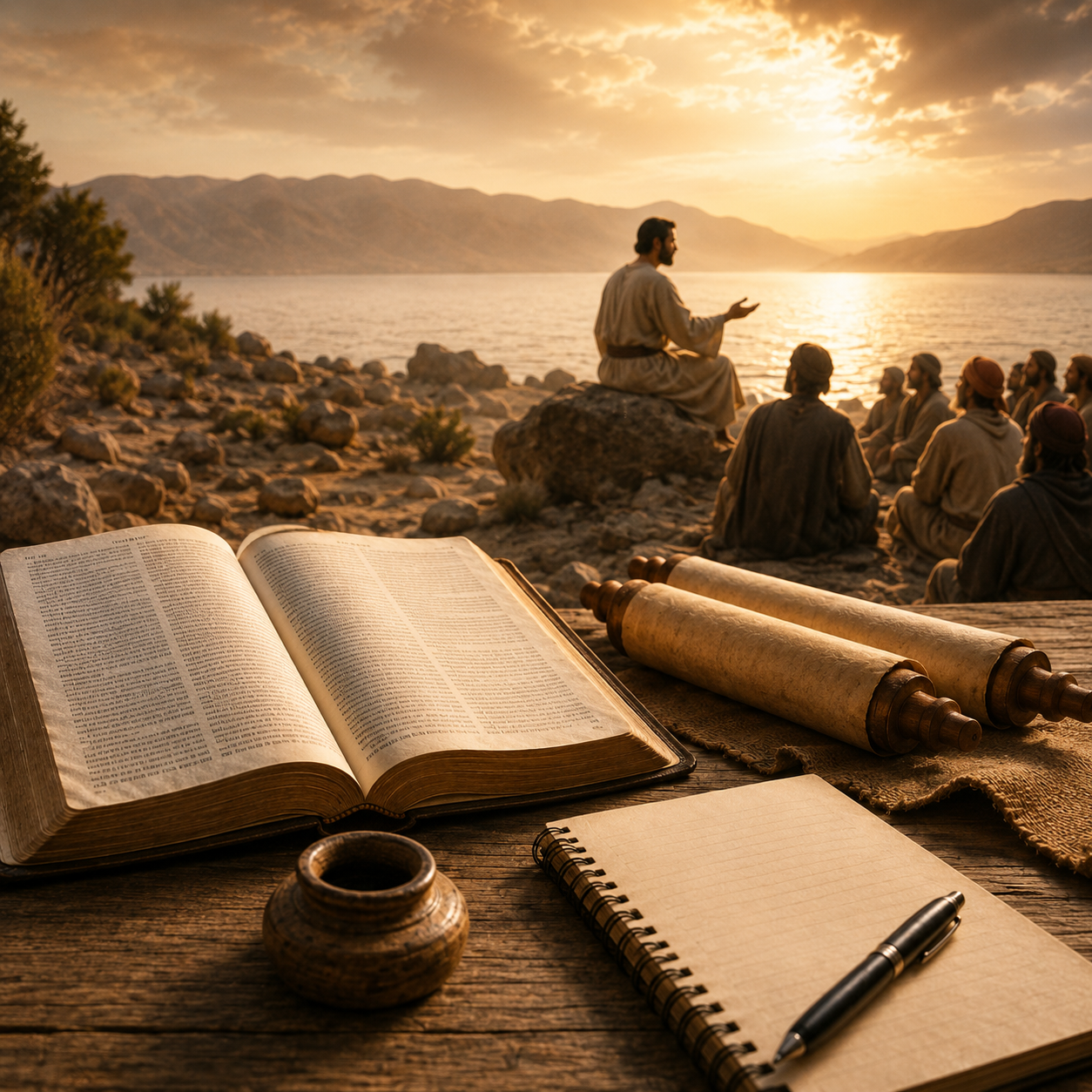
The Gospel accounts present Jesus Christ through the testimony of those who saw, heard, and followed Him—independent witnesses whose accounts fit together in remarkable ways.
Matthew emphasizes Jesus as the promised King and the fulfillment of prophecy. Mark moves quickly and emphasizes action, urgency, and the suffering Servant. Luke writes as a careful investigator, giving an orderly account and frequently drawing attention to people others might overlook. John gives a more reflective account, emphasizing Jesus Christ’s identity as the Son of God.
These differences do not weaken their testimony. They are exactly the kinds of differences we would expect from independent witnesses.
John explicitly identifies himself as a witness: “He who has seen has testified, and his testimony is true” (John 19:35). He closes his Gospel by saying: “This is the disciple who testifies of these things, and wrote these things; and we know that his testimony is true” (John 21:24).
John makes the same point even more forcefully in his first epistle. He writes about what the disciples had heard, seen with their eyes, looked upon, and even handled with their hands (1 John 1:1).
Luke openly tells us that he investigated what had been handed down by those “who from the beginning were eyewitnesses.”
Paul went even further. Writing within the lifetime of the earliest Christians, he reminded his readers that the resurrected Christ had appeared to more than five hundred people at one time and that many of those witnesses were still alive.
In other words, the claim was made while people who could challenge it were still around.
The Gospels Include Unflattering Details
Another characteristic of the Gospel accounts that I find persuasive is this: The disciples do not make themselves look very good.
If you were inventing a religion and wanted people to regard you as one of its great heroes, would you repeatedly record your own failures?
Peter denies Jesus three times. The disciples argue over which one of them is the greatest. They fall asleep when Jesus asks them to remain awake and pray with Him. They misunderstand His teachings. They run away when He is arrested. Even after the resurrection, Matthew records that “some doubted” (Matthew 28:17). That is an extraordinary admission.
The Gospel writers were apparently less concerned with protecting their reputations than with recording what happened.
The women discovering the empty tomb first is another important example. In the culture of that time, women’s testimony did not carry the same public weight as men’s. If someone were inventing the resurrection story merely to make it as persuasive as possible to a first-century audience, women would be an unusual choice as the first witnesses. Yet all four Gospels preserve this basic fact.
Why?
The simplest explanation is that this is what happened.
The Little Details That Fit Together
Perhaps my favorite evidence is found in what are sometimes called undesigned coincidences. These occur when one Gospel contains a detail that raises a question, while another Gospel unintentionally provides the answer.
A wonderful example occurs in the feeding of the five thousand.
John tells us: “Then Jesus lifted up His eyes, and seeing a great multitude coming toward Him, He said to Philip, ‘Where shall we buy bread, that these may eat?’“ (John 6:5).
That raises a reasonable question.
Why Philip?
Jesus had twelve apostles. Why would He specifically ask Philip where food could be purchased?
John never tells us. But Luke gives us another detail. Luke says that the miracle occurred near Bethsaida. That may not immediately appear significant until we read something John mentioned much earlier: “Now Philip was from Bethsaida, the city of Andrew and Peter” (John 1:44).
Now the pieces fit together. Luke tells us where they were. John tells us where Philip was from. Neither writer stops to explain the connection.
But suddenly Jesus asking Philip where food could be purchased makes perfect sense. They were near Philip’s hometown. If anyone among the disciples might know the area, nearby villages, and where provisions could be obtained, Philip would be an obvious person to ask.
That is the kind of incidental detail that is difficult to manufacture. Luke supplies the where. John supplies the who. Together they naturally explain the why.
And there are many more examples.
Luke tells us that Herod heard about Jesus and “was perplexed” (Luke 9:7). Matthew supplies the reason: Herod believed Jesus might actually be John the Baptist raised from the dead (Matthew 14:1–2).
Luke says that “one of them” cut off the ear of the high priest’s servant when Jesus was arrested. John identifies the disciple as Peter and even gives us the servant’s name—Malchus.
John tells us Peter had a sword in Gethsemane. Luke had already mentioned that the disciples possessed two swords.
Mark tells us Jesus went to Gethsemane. John adds the seemingly incidental information that Judas knew exactly where to find Him because Jesus often met there with His disciples.
Luke says the disciples were terrified when the resurrected Jesus appeared to them. John provides another detail: the doors were shut because the disciples were afraid.
Again and again, one Gospel contains a detail that naturally fits with something recorded elsewhere.
No Gospel writer announces, “I am giving you this information to prove that the other Gospel is accurate.” The details simply fit. That is what makes them so powerful.
How Did Matthew Know What Happened in Herod’s Court?
There is another interesting example.
Matthew gives us surprisingly detailed information about what Herod Antipas said and did in his own court.
Matthew writes: “At that time Herod the tetrarch heard the report about Jesus and said to his servants, ‘This is John the Baptist; he is risen from the dead’” (Matthew 14:1–2).
How did followers of Jesus, specifically the writer Matthew, know what Herod was saying to his servants?
Matthew also gives details about Herod’s birthday celebration, the dancing of Herodias’ daughter, the oath Herod made, the request for John the Baptist’s head, and even Herod’s emotional reaction to the request.
Where could information like that have come from?
Luke gives us a fascinating clue. Among the women who supported Jesus’ ministry was “Joanna the wife of Chuza, Herod’s steward” (Luke 8:3).
Think about that. Someone closely connected with Herod’s household was also closely connected with Jesus’ ministry.
Luke does not mention Joanna in order to explain Matthew. Matthew does not mention Joanna as his source. Yet the accounts fit naturally together.
Once again, one writer provides information that helps explain how another writer could have known something.
A Network of Witnesses
The Christian faith did not originate with one anonymous person making an unverifiable claim.
Matthew was one of the Twelve. John repeatedly identifies himself as an eyewitness. Mark was closely associated with Peter, and early Christian testimony connects his Gospel with Peter’s preaching. Luke tells us directly that he carefully investigated the accounts given by eyewitnesses. Paul personally knew Peter, James, John, and others who had known Jesus during His earthly ministry. He also appealed to hundreds of people who claimed to have seen the resurrected Christ.
This creates a network of testimony. The accounts can be compared. Different perspectives can be examined. We can test small details against one another. And the more closely we examine them, the more interesting these connections become.
We Are Witnesses, Too
But this subject has another side.
After His resurrection, Jesus told His disciples: “You shall receive power when the Holy Spirit has come upon you; and you shall be witnesses to Me in Jerusalem, and in all Judea and Samaria, and to the end of the earth” (Acts 1:8).
Those disciples were witnesses in a way we can never be. They physically walked with Jesus. They heard His voice. They saw His miracles. They saw Him alive after His crucifixion.
We did not.
Yet, God’s people have always been called to be witnesses.
God told Israel: “‘You are My witnesses,’ says the LORD,’And My servant whom I have chosen,That you may know and believe Me, And understand that I am He’“ (Isaiah 43:10).
A witness tells what he knows. A witness testifies to what he has seen and experienced.
I cannot tell you that I personally stood outside the empty tomb. I cannot claim that I watched Jesus feed five thousand people or saw Him walk on water. But I can tell you what God has done in my life.
I have seen God deliver me from situations I could not control. I have experienced answers to prayer. I have experienced His mercy, His correction, His protection, and His forgiveness.
Years ago, I was driving at night on a mountainous road when another vehicle began deliberately ramming the back of my car. I was shocked when the vehicle struck me again. This was no accident. I sped up to get away. As the vehicle repeatedly struck me while we traveled at high speeds on a winding mountain road, I realized he appeared to be trying to force me off the road.
I believed I was about to die. I thought I would surely be pushed off the side of the mountain. There was very little I could do.
So I cried out to God. The exact moment I called out, I came over a hill, and there was a police vehicle directly in front of me. I began flashing my lights. The other car struck me again. I got the police car to stop; I explained what was happening, and the officers pursued the other driver and made an arrest.
Can I explain everything God was doing behind the scenes that night?
No.
But I know what happened. When I was powerless, I called out to God, and help was already positioned on that road before I ever knew I would need it.
That is my testimony. And that is what witnesses do. We say, “This is what I know. This is what I have seen. This is what God has done.”
The question is not only whether we can trust the witnesses recorded in the Gospels. I believe the evidence says that we can. The question becomes: Can we be trusted as witnesses?
If the apostles were willing to devote their lives to proclaiming that Jesus Christ rose from the dead, and if God calls His people His witnesses, then our lives should provide evidence that what we proclaim is real.
We cannot proclaim a risen Christ while living as though He is still in the tomb. We cannot proclaim a coming Kingdom while living entirely for this present world. We cannot testify that Jesus delivers people from sin while refusing to turn away from the very sins He died to forgive.
In a sense, the courtroom is still in session. The world is still examining the witnesses. And the verdict proclaimed by the Gospel remains the same:
Jesus Christ lived.
Jesus Christ died.
Jesus Christ rose from the dead.
And Jesus Christ is coming again.
Now God calls us to the witness stand; not merely through what we say, but through our actions, our character, our faithfulness, our courage, our repentance, our love, and our endurance.
May we live in such a way that when people examine the evidence of our lives, they do not see a contradiction to the Gospel.
May they see a living testimony that Jesus Christ is real, His Word is true, and His Kingdom is worth everything.
We are witnesses of these things.